


Disclosure: This article contains affiliate links. We may earn a commission from purchases at no extra cost to you, which helps our travel content.
The taxi driver's weathered face creases into a puzzled smile when I tell him my destination. 'Nouadhibou? Pourquoi?' he asks – Why? It's a fair question. Most travelers to West Africa bypass Mauritania entirely, let alone venture to its second-largest city, a windswept peninsula jutting into the Atlantic where the Sahara meets the sea in a collision of worlds. I've spent two decades seeking these ecological transition zones, the places where one ecosystem bleeds into another, creating something altogether unique. After months researching Mauritania's coastal desert frontier, I knew Nouadhibou would offer that rare convergence I crave – a place where natural extremes meet human resilience in equal measure. As we drive north from Nouakchott along a ribbon of asphalt cutting through endless dunes, I'm reminded that the most profound journeys often begin with a question mark rather than an exclamation point. Two weeks in a place most can't pronounce, let alone locate on a map – this is exactly where I need to be.

Arriving at the Edge of Elsewhere
After fourteen hours on the iron ore train from Choum – arguably the world's most extreme public transportation experience – I arrive in Nouadhibou caked in fine red dust that has infiltrated every crease of clothing, every pore of skin. The journey itself merits its own story: rattling through the night across the Sahara atop open-air cargo wagons filled with iron ore, wrapped in layers against the bitter desert cold, watching stars wheel overhead with crystalline clarity. The train delivers me not to a station, but unceremoniously deposits passengers at dawn alongside industrial tracks at the city's edge.
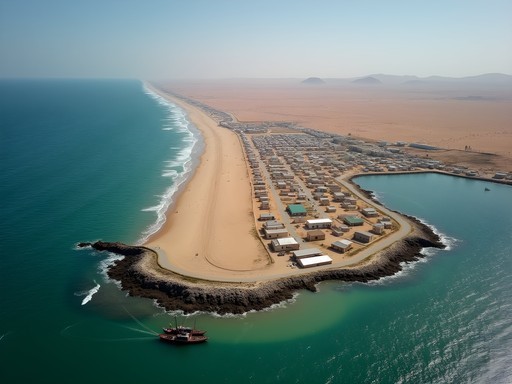
Nouadhibou stretches across a narrow peninsula, with the protected bay of Cansado to the east and the wild Atlantic to the west. The layout is disorienting – a grid of sandy streets interrupted by occasional paved roads, buildings in various states of completion or decay, and always the presence of water on multiple horizons, a surreal sight after days in the desert interior.
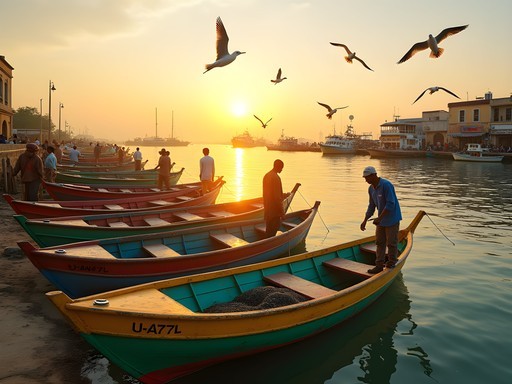
I check into Hotel Sahara, a modest establishment where the proprietor, Mohamed, greets returning guests like family. At $18 per night, my simple room offers the essentials: a clean bed, surprisingly reliable hot water, and a ceiling fan that battles valiantly against the coastal humidity. The rooftop terrace becomes my evening refuge, offering panoramic views across the peninsula as fishing boats return to harbor trailing seabirds in their wake.
My satellite messenger proves invaluable here, where cell service exists but remains unreliable beyond city limits. Each night I send predetermined messages to my partner in Boston – a digital breadcrumb confirming my safety in this remote corner of West Africa.

💡 Pro Tips
- Book Hotel Sahara in advance via email rather than online platforms for better rates
- Bring sufficient cash in euros as ATMs are unreliable and many places don't accept cards
- Purchase a local SIM card immediately upon arrival for basic connectivity
The Graveyard of Ships
Nouadhibou harbors a macabre attraction that draws the few travelers who venture here: one of the world's largest ship graveyards. Over 300 rusting vessels line the southern coastline, abandoned due to changing fishing regulations, insurance fraud, or simple obsolescence. I arrange a tour with Hakim, a former fisherman who navigates the political sensitivities of photographing these maritime skeletons – technically forbidden, but possible with local guidance.
We drive along the coast in his battered Toyota, the ocean breeze carrying the metallic tang of oxidizing steel. Hakim points out vessels with histories more complex than their rusting exteriors suggest – Ukrainian fishing trawlers, Spanish cargo ships, even a former Soviet scientific vessel. Each has been stripped of anything valuable, leaving behind hulking monuments to maritime commerce.
'Before cameras, you must understand the context,' Hakim insists, explaining how lax environmental regulations once made Nouadhibou a convenient disposal site. 'Now the government tries to clean, but the task is enormous.'
We walk carefully among the nearest wrecks, their hulls partially submerged in sand and shallow water. Ravens nest in abandoned wheelhouses. The textures are a photographer's dream – rust blooms across metal surfaces in fractal patterns, creating natural abstractions against the stark blue sky. I'm grateful for my weather-resistant camera as salt spray occasionally gusts inland when waves break against the decaying hulls.
The ship graveyard embodies the environmental contradictions I've encountered throughout my travels – simultaneously a man-made ecological problem and a hauntingly beautiful landscape. I spend hours photographing the interplay of natural reclamation and human abandonment, watching as sunset transforms the rusting giants into bronze sculptures against the darkening sea.

💡 Pro Tips
- Hire a local guide like Hakim through your hotel for access to the ship graveyard
- Bring a telephoto lens for detailed shots of distant vessels
- Visit in late afternoon when the light transforms the rusting metal into photographic gold
Desert Meets Ocean: The Cap Blanc Peninsula
The true ecological marvel of Nouadhibou lies at its northernmost reach – Cap Blanc (or Ras Nouadhibou), where the peninsula narrows to a sandy spine with Morocco's contested Western Sahara territory visible across a narrow strait. This remote headland hosts one of nature's most improbable sanctuaries: the largest surviving colony of Mediterranean monk seals.
Reaching the cape requires permits and persistence. After three days of bureaucratic negotiations facilitated by my hotel owner, I secure passage with a research monitoring team making their monthly census. We depart before dawn in a sturdy 4x4, the binoculars I've carried through a dozen countries hanging ready around my neck.
The landscape transforms as we travel northward – first through the city's industrial outskirts, then past military checkpoints, and finally onto unmarked tracks through wind-sculpted dunes that cascade directly into the Atlantic. The peninsula narrows until water flanks both sides of our route, creating the disorienting sensation of driving atop the ocean itself.
'There,' whispers Mariam, the Mauritanian marine biologist leading our expedition, pointing toward a cluster of dark shapes on distant rocks. Through my binoculars, I distinguish the sleek forms of monk seals hauled out on the shoreline – members of a species numbering fewer than 700 worldwide. Their presence here, where the harshest desert on earth meets the sea, feels like a biological impossibility made real.
We spend hours observing from a respectful distance as Mariam records identifying markings and behavior patterns. The seals seem equally curious about us, occasionally raising their heads to assess our presence before returning to their sun-soaked slumber. When a mother and pup emerge from the water to join the colony, even the researchers exchange excited whispers – new births represent hope for this critically endangered species.
The convergence of ecosystems here creates a unique microclimate. Ocean fog rolls across desert dunes, sustaining patches of vegetation that shouldn't logically exist. Coastal birds I recognize from other continents feed alongside desert specialists. It's precisely this type of ecological transition zone that first drew me to environmental writing – places where established rules bend and adaptation creates unexpected possibilities.

💡 Pro Tips
- Arrange permits for Cap Blanc through your accommodation at least 3-4 days in advance
- Bring at least 2 liters of water per person even for short excursions
- Pack layers – the temperature difference between sunny areas and fog-covered sections can exceed 20°F

Into the Void: Desert Expedition to Adrar
Nouadhibou's true value to adventure travelers lies in its position as the northern gateway to Mauritania's interior – specifically, the legendary Adrar region with its ancient caravan cities and star-dune formations. After a week exploring the peninsula, I connect with Ibrahim, a Tuareg guide recommended by fellow travelers encountered in Senegal months earlier.
Planning a desert expedition requires meticulous preparation. We spend two days gathering supplies in Nouadhibou's markets – everything from fuel reserves to dried camel meat, negotiations conducted in a blend of broken French and hand gestures. Ibrahim inspects my gear with critical eyes, approving my desert-tested clothing and water filtration system but insisting I purchase additional head coverings against sandstorms.
We depart before sunrise in Ibrahim's modified Land Cruiser, heading east away from the coast. The transition is abrupt – within an hour, all traces of maritime influence vanish, replaced by a landscape of increasing desolation. The paved road ends unceremoniously, continuing as a track marked only by the passage of previous vehicles across stone and sand.
'Now we are truly in the Sahara,' Ibrahim announces as we stop to deflate tires for better traction. The silence is absolute, broken only by the whisper of wind across dunes. Having spent significant time in the American Southwest and Australia's outback, I'm still unprepared for the Sahara's scale – an ocean of land where distance becomes an abstract concept rather than a measurable quantity.
Over the next five days, we travel deeper into Adrar province, camping each night beneath stars so brilliant they cast shadows. We visit the ancient desert trading post of Chinguetti, where libraries hold manuscripts dating back centuries, protected from the desert's harsh elements by traditional methods passed through generations. In the Richat Structure – the 'Eye of the Sahara' visible from space – we hike across geological formations that have puzzled scientists for decades.
Throughout the journey, Ibrahim shares Tuareg perspectives on the landscape, pointing out navigation markers invisible to untrained eyes and identifying plants with medicinal properties. These indigenous knowledge systems reflect generations of adaptation to one of Earth's most challenging environments – the kind of deep ecological understanding increasingly lost in our digitized world.
Returning to Nouadhibou after our interior expedition, the city's modest amenities suddenly seem luxurious. The first shower washing away days of accumulated desert dust becomes a transcendent experience. Even the simplest meal of fresh fish tastes extraordinary after days of preserved provisions.

💡 Pro Tips
- Book desert guides through personal recommendations rather than online – reputation is everything in the Sahara
- Register your expedition with your embassy before departing Nouadhibou
- Pack twice as many batteries/power banks as you think you'll need – solar options are unreliable during sandstorm season
The Fishing Life: A Day with Imraguen Fishermen
My final days in Nouadhibou are spent exploring its primary economic engine – the fishing industry that sustains the city despite its remote location. Through connections at my hotel, I arrange to join an Imraguen fishing crew for a day at sea. The Imraguen are indigenous fishermen whose traditional methods date back centuries along Mauritania's coast.
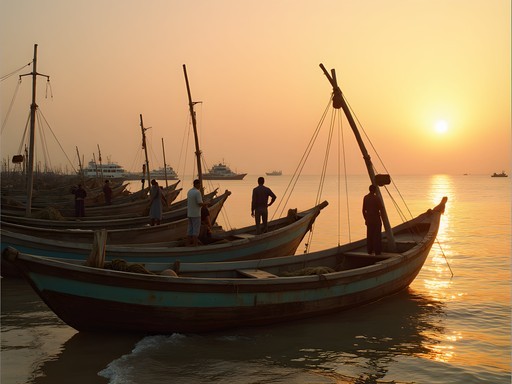
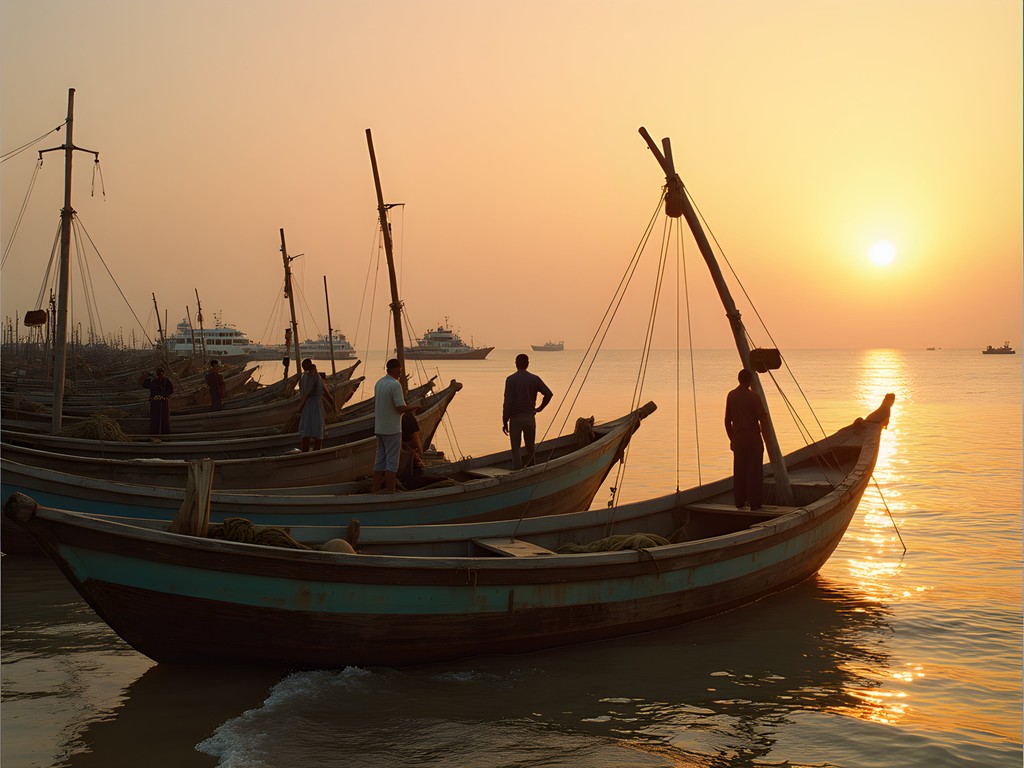
We launch before dawn from the commercial harbor, navigating past larger industrial vessels toward the open Atlantic. The wooden boat, called a lanche, creaks reassuringly as we cut through gentle swells. Captain Sidi, whose father and grandfather fished these same waters, navigates by memory and subtle environmental cues rather than instruments.
'Today good day for fish,' he declares confidently in limited English, pointing to patterns in the water visible only to experienced eyes. 'Birds tell us where to look.'
Indeed, as the sun rises, we follow congregations of seabirds to locate schools of fish. The crew works with practiced efficiency, deploying nets using techniques that minimize bycatch of unintended species. I assist where possible but primarily observe, documenting their methods with my waterproof camera as we roll on the ocean swells.
By midday, the boat's hold contains a modest but diverse catch – primarily mullet and sea bream destined for local markets rather than export. As we prepare to return to harbor, Sidi demonstrates traditional fish preservation methods passed through generations, showing me how certain species are dried using only sea salt and sun.
The Imraguen face mounting challenges from industrial fishing fleets that have depleted stocks through unsustainable practices. Their traditional knowledge – including seasonal migration patterns and sustainable harvest methods – represents an alternative approach to resource management increasingly validated by marine conservation science.
Back at harbor, I witness the economic ecosystem surrounding the catch – the rapid sorting, negotiating, and distribution that connects these fishermen to the broader community. Women predominate in the processing work, their hands moving with remarkable speed to clean and prepare fish for market. The entire scene operates on implicit understanding rather than formal structure – a community economic system evolved over generations.
💡 Pro Tips
- Arrange fishing excursions through your hotel rather than directly at the harbor
- Bring motion sickness medication even if you normally have good sea tolerance
- Wear clothes you don't mind getting permanently fish-scented
Final Thoughts
As my taxi returns along the same desert highway toward Nouakchott's international airport, I find myself reluctant to leave Nouadhibou behind. This overlooked coastal outpost offers precisely what I seek in travel – authentic cultural exchanges, ecological marvels where disparate worlds collide, and landscapes that remain genuinely wild rather than curated for tourism. The challenges of visiting – bureaucratic hurdles, limited infrastructure, communication barriers – serve as effective filters, preserving experiences increasingly rare in our hyperconnected world. For the right traveler – self-sufficient, patient, and genuinely curious – Nouadhibou offers not just a gateway to Saharan adventure but a destination worthy in itself. As the peninsula recedes in the distance, I'm already planning my return during the opposite season, when different migratory species pass through this remarkable convergence of desert and sea. Some places leave their mark not through conventional beauty but through the raw authenticity of their character. Nouadhibou is unmistakably such a place – a reminder that the most profound travel experiences often await where the question 'Why there?' is met with the simple answer: 'Because few do.'
✨ Key Takeaways
- Nouadhibou offers unique access to both maritime ecosystems and Saharan desert expeditions
- Local guides are essential for navigating both cultural protocols and remote regions safely
- The ecological transition zone between ocean and desert creates biodiversity hotspots worth exploring
- Winter provides the most comfortable temperatures for both coastal and interior exploration
📋 Practical Information
Best Time to Visit
November through February (winter)
Budget Estimate
$30-50 per day excluding desert expeditions
Recommended Duration
7-14 days
Difficulty Level
Challenging
Comments
Jose McDonald
YES! Finally someone writing about Mauritania! This country is so underrated it hurts. I did a similar route last year and the Adrar region absolutely blew my mind. Those desert landscapes are on another level - like Mars but better. Pro tip: bring way more water than you think you need for desert trips. I learned that the hard way. Also, the locals in Nouadhibou were some of the most welcoming people I've met anywhere. They seemed genuinely stoked that tourists were interested in their city. The seafood restaurants near the port are insanely good and cheap. Can't wait to go back!
escapeseeker
How much French do you need to get by there?
Jose McDonald
Basic French helps a lot but you can manage with hand gestures and a smile. Download Google Translate offline just in case!
globeking
What's the best time of year to visit? And can you actually walk around the ship graveyard or is it restricted?
Jose McDonald
November to February is ideal - not too hot. You can definitely explore the ships but be careful, some are pretty rusted out!
escapeseeker
Adding this to my bucket list!
Oliver Duncan
Riley, this is brilliant mate. I spent three weeks in Mauritania last year and Nouadhibou was a highlight I wasn't expecting. That moment when you first see the ship graveyard stretching along the coast - absolutely haunting. I met this old fisherman who told me stories about each ship while we shared tea. He remembered when some of them were still operational. The tea culture there is incredible - I must have drunk 50 tiny glasses a day! One tip for readers: bring a good headlamp. Power cuts are frequent and you'll want it for navigating at night.
winterchamp
Is it easy to get a visa for Mauritania? And how did you arrange the desert expedition?
Oliver Duncan
Not Riley but I can help - you can get visa on arrival at Nouakchott airport. Bring USD cash though, they don't always take cards. For desert trips, best to arrange locally through your accommodation.
skydiver1062
Wow, this brings back memories! I passed through Nouadhibou in 2023 on the iron ore train from Choum - absolutely wild experience. That ship graveyard is surreal in person, even more than the photos show. The locals were super friendly once they realized I wasn't just another fishing industry worker. Did you try any of the fresh fish at the port? Some of the best seafood I've had anywhere. The contrast of desert and ocean is something else.
winterchamp
How safe did you feel there? Been wanting to explore this region but always hear mixed things
skydiver1062
Honestly felt totally fine. Just use common sense like anywhere. Stick to daylight hours for wandering around and you're good
moonvibes
This is exactly the kind of adventure I'm looking for!! So tired of the same old tourist spots. The ship graveyard looks like something from another planet. Adding this to my 2027 plans for sure!
Taylor Moreau
Excellent piece, Riley. Nouadhibou is genuinely one of West Africa's most underrated destinations. I spent three days there in 2024 researching sustainable tourism initiatives in the region. The contrast between the industrial fishing port and the pristine Cap Blanc coastline is extraordinary. For anyone planning a visit, I'd strongly recommend arranging your Adrar desert expedition through local operators in advance - the infrastructure is minimal and you'll want reliable 4x4 support. Also worth noting: French is essential here, very little English spoken outside the main hotels.
moonvibes
good to know about the French! might need to brush up before I go
tripone
This looks incredible!
roamlover8483
What's the visa situation like for Mauritania? Is it complicated to get in?
Taylor Moreau
You can get visa on arrival at Nouadhibou airport for most nationalities - costs around €60. Just make sure you have proof of yellow fever vaccination and accommodation booking. The process took me about 45 minutes when I visited last year.
roamlover8483
perfect thanks!
Venture X
Premium card with 2X miles, $300 travel credit, Priority Pass