



Disclosure: This article contains affiliate links. We may earn a commission from purchases at no extra cost to you, which helps our travel content.
The transformation of Kinshasa after sunset follows principles not unlike quantum mechanics – a dramatic shift in state that must be experienced to be understood. Having spent decades observing wave patterns in laboratory settings, I find myself increasingly drawn to the human wave patterns that emerge in urban centers after dark, particularly in cities where the conventional tourist rarely ventures. Kinshasa, the sprawling capital of the Democratic Republic of Congo, represents one of the most fascinating nocturnal energy systems I've encountered in my travels. Here, the collision of colonial history, indigenous rhythms, and modern urban dynamics creates a nightlife scene that defies the simplistic narratives often associated with Central African metropolises. Over the course of one illuminating week, I immersed myself in this complex social ecosystem, armed with nothing more than my curiosity, a handful of local contacts, and my trusty light-sensitive camera equipment.

The Physics of Rumba: Kinshasa's Sonic Heartbeat
The Congolese rumba scene represents what physicists might call a self-organizing system – chaotic at first glance yet governed by intricate patterns that reveal themselves to the patient observer. My exploration began at Chez Ntemba, perhaps the most storied nightclub in Kinshasa, where the acoustic properties of the space have been inadvertently perfected through decades of musical evolution.
What fascinates me about Congolese rumba is how the sound waves interact with human movement. Unlike European club settings where bass frequencies dominate, the mid-range guitar patterns in rumba create standing wave patterns that seem to propel dancers forward in oscillating motions. I spent three consecutive nights here, arriving progressively later each evening as I adjusted to the local rhythm – in Kinshasa, serious dancing rarely begins before midnight and continues well past dawn.
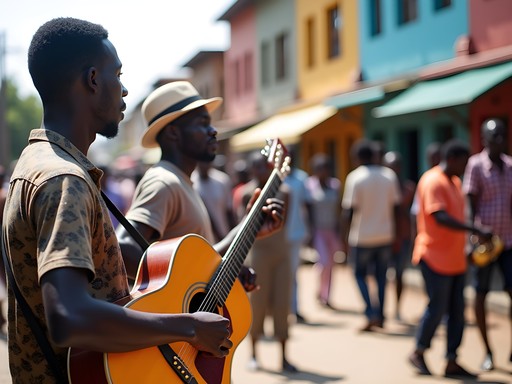
The club's legendary status is well-earned; musicians who have played with bands like Zaiko Langa Langa and OK Jazz often make impromptu appearances. On my second night, I witnessed a guitar player in his seventies join the house band, his fingers creating melodic patterns that younger musicians immediately adapted to – a perfect example of wave interference patterns in cultural transmission.
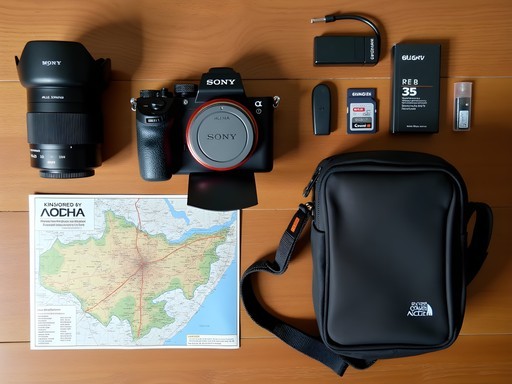
For capturing these moments, I relied heavily on my low-light camera, which handles the challenging lighting conditions of Kinshasa's clubs remarkably well. The ability to shoot at high ISO without significant noise proved invaluable for documenting these vibrant scenes without disrupting them with flash photography.

💡 Pro Tips
- Arrive after midnight for authentic rumba experiences
- Dress smartly – Kinshasa's club scene values elegant attire
- Learn basic Lingala phrases to connect with musicians and dancers
Jazz Moderne: Where Kinshasa Meets the World
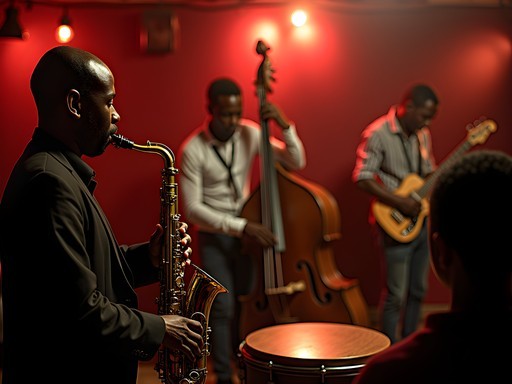
If rumba represents Kinshasa's traditional sonic identity, the city's burgeoning jazz scene demonstrates how cultural wave functions can overlap and create new harmonics. At Jazzekissa, a venue tucked away in the Matonge district, I discovered how Congolese musicians are reinterpreting global jazz traditions through local instrumental techniques.
The acoustics of this space deserve particular mention. Unlike the cavernous rumba clubs, Jazzekissa features low ceilings and sound-absorbing materials that create an intimate listening environment. The owner, a former sound engineer named Pascal, explained to me how he designed the space specifically to minimize standing wave patterns that plague many jazz venues. The result is a clarity of sound that allows the complex harmonics of Congolese jazz fusion to be fully appreciated.
What struck me most was the temporal patterns of the performances. Western jazz typically follows predictable time signatures, but here I observed musicians shifting between 6/8 and 4/4 with a fluidity that created fascinating polyrhythmic interference patterns. One particularly memorable quartet featured a likembe (thumb piano) player whose overtones created unexpected harmonics with the saxophone.
For these late-night sessions that often stretch until dawn, I found my portable espresso maker to be an essential companion. The ability to brew a proper espresso in the quiet moments between sets kept me alert and receptive to the subtle musical innovations unfolding around me.

💡 Pro Tips
- Visit Jazzekissa on Wednesday nights for the best local talent
- Purchase CDs directly from musicians – they're often unavailable elsewhere
- Request a table near the back wall for optimal acoustics
Kinshasa's Rooftop Revolution
The vertical dimension of Kinshasa's nightlife reveals another fascinating pattern: as elevation increases, social demographics shift in predictable waves. The emergence of rooftop venues across the city represents both a practical solution to urban density and a social stratification mechanism.
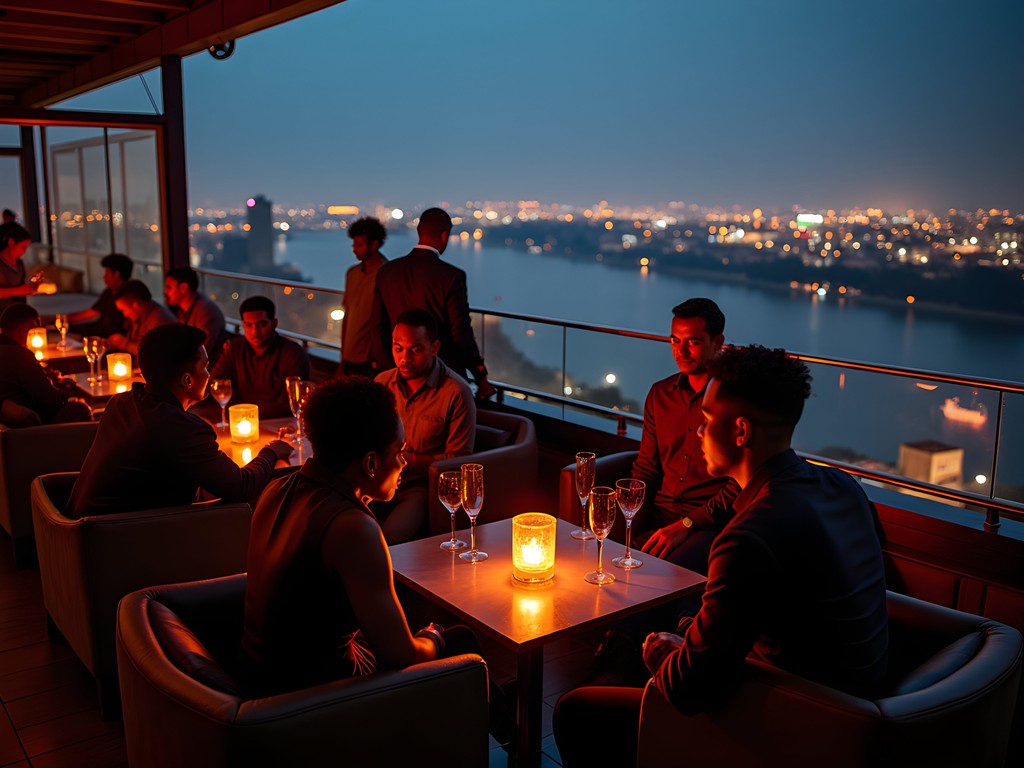
At Le Rooftop in Gombe district, I observed how altitude literally changes the acoustic experience of the city. From fifteen stories up, the omnipresent bass frequencies of street-level clubs are filtered out, creating a sonic environment dominated by mid and high frequencies. This acoustic phenomenon is complemented by the visual experience – the chaotic light patterns of the city below contrasted with the precisely controlled LED systems of the venue itself.
What makes these spaces particularly interesting from a physics perspective is the thermal dynamics at play. While street-level venues in Kinshasa often become uncomfortably hot as the night progresses (a function of body heat, limited ventilation, and inconsistent electricity), rooftop venues benefit from natural air circulation patterns. The temperature differential creates convection currents that not only make these spaces more comfortable but also affect how sound travels across them.
The clientele at these elevated venues tends toward Kinshasa's cosmopolitan elite – diplomats, expatriates, and the local business class – creating a social atmosphere distinct from the more democratic energy of ground-level establishments. As someone who has studied wave patterns across different media, I found the stratification of nightlife by altitude to be a perfect metaphor for how social energy distributes itself across urban environments.
For navigating between these various nightlife elevations safely, I relied on my compact flashlight. Kinshasa's street lighting can be unpredictable, and having a reliable light source proved essential for moving between venues, especially in areas where taxis are scarce after certain hours.
💡 Pro Tips
- Make reservations for rooftop venues at least a day in advance
- Bring cash as card payment systems frequently malfunction
- Request a corner table for the best views of both the city and the social dynamics

The Matonge District: Cultural Brownian Motion
No exploration of Kinshasa's nightlife would be complete without immersion in Matonge, the district that exemplifies what physicists might call Brownian motion in human form. Named after a neighborhood in Brussels (itself named after a Congolese village), Matonge represents cultural feedback loops across continental boundaries.
The density of establishments in Matonge creates a phenomenon where sound waves from different venues interact in complex interference patterns. Walking down Avenue Kasai after midnight, one experiences a sonic gradient as competing musical forms – rumba, soukous, ndombolo, and imported hip-hop – blend and separate with each step. This acoustic environment mirrors the social mixing that occurs here, where rigid class structures temporarily dissolve.
At Chez Fatou, a venue legendary among locals but absent from any tourist literature, I witnessed how space constraints affect social dynamics. The venue's narrow dimensions force dancers into proximity patterns that would be considered uncomfortable in Western contexts but generate a collective energy that transforms individual movements into synchronized wave functions. The resulting dance formations bear striking resemblance to particle behavior in superheated states.
What makes Matonge particularly fascinating is its temporal unpredictability. Unlike the structured programming of upscale venues, nightlife here follows emergent patterns that cannot be predicted in advance. A quiet bar can transform into the epicenter of activity based on the arrival of a single influential patron or musician, demonstrating principles not unlike phase transitions in physical systems.
Navigating this dynamic environment requires both local knowledge and physical stamina. My background in hiking served me well during these explorations, though I found my water purification bottle to be an essential companion. Staying hydrated is crucial during long nights of dancing, and having the ability to safely refill from any water source provided peace of mind in areas where bottled water isn't always readily available.

💡 Pro Tips
- Follow crowds rather than guidebook recommendations in Matonge
- Carry small denominations of US dollars alongside Congolese francs
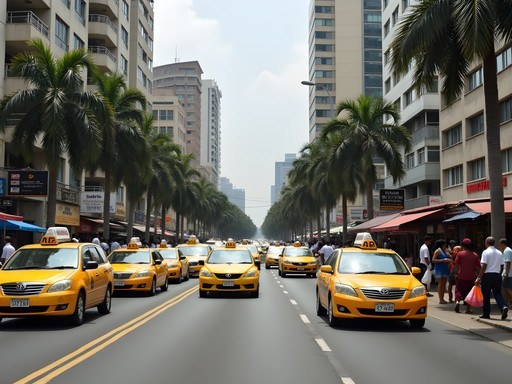
- Make friends with a taxi driver who can serve as both guide and transportation
Kinshasa's Temporal Rhythms: A Physicist's Perspective
What continues to fascinate me about Kinshasa's nightlife is how it defies conventional temporal boundaries. As someone who has studied time dilation effects in physics, I find the city's relationship with nocturnal hours to be a perfect social parallel to relativistic phenomena.
Unlike European or North American cities where nightlife follows predictable patterns tied to work schedules, Kinshasa operates on what I've come to think of as 'elastic time.' The city's frequent power outages have created a culture where rigidly scheduled events are impractical, leading instead to a fluid approach to nocturnal activities that expand and contract based on energy availability, both electrical and human.
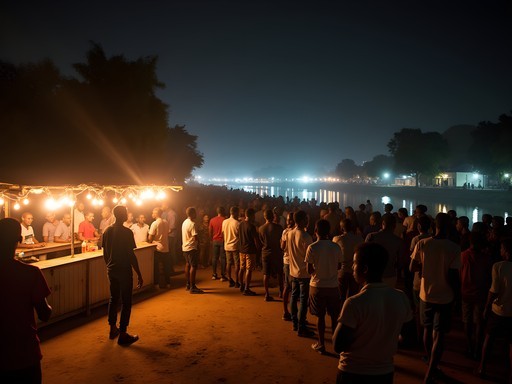
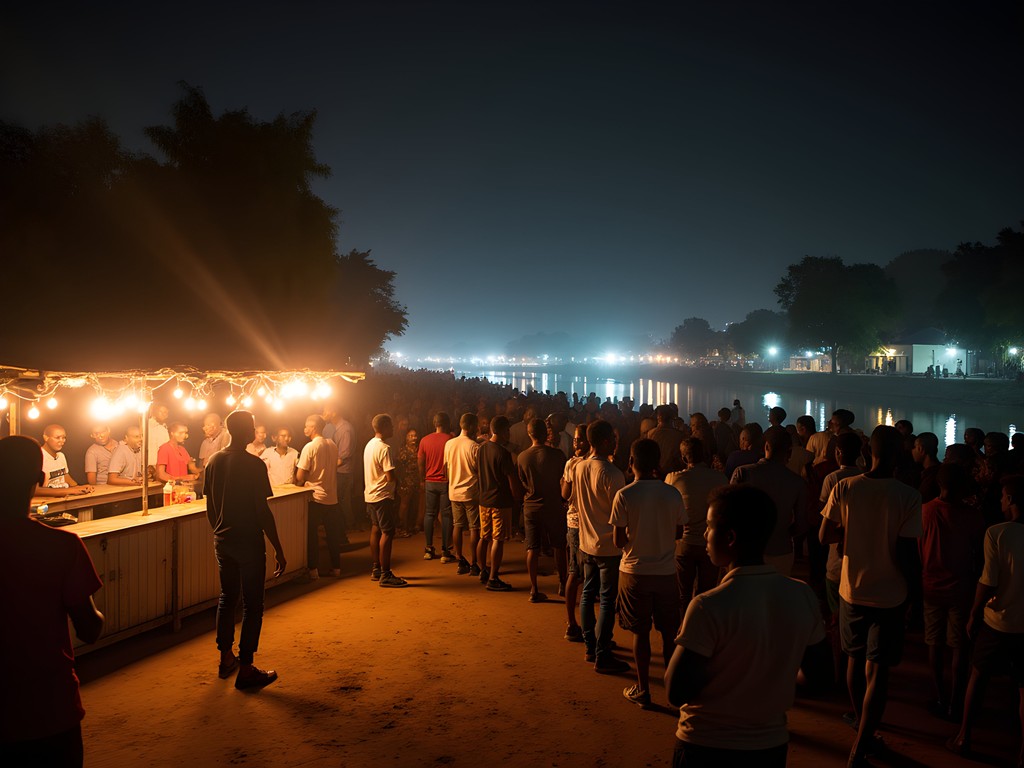
At Kintambo Magasin, a sprawling complex of bars and food stalls near the Congo River, I observed how these temporal patterns manifest. Activity might surge suddenly at 3 AM when electricity returns to the district, creating impromptu gatherings that would be considered unusual at such hours in other global cities. Conversely, what appears to be a promising venue at 10 PM might suddenly empty if word spreads of a more energetic scene elsewhere.
This temporal fluidity extends to the music itself. While Western club music typically maintains consistent beats-per-minute within specific genres, Kinshasa's DJs and live musicians frequently manipulate tempo in ways that would be jarring in other contexts. I recorded several instances where tempos gradually increased over hours-long sets, creating a barely perceptible acceleration that nonetheless dramatically affected crowd energy – not unlike how gradual frequency shifts can fundamentally alter wave behavior in physical systems.
For those attempting to navigate this temporal landscape, maintaining energy becomes a practical challenge. I found my electrolyte tablets invaluable for sustaining stamina through long nights that often blended into mornings. The ability to quickly replenish electrolytes lost through dancing proved essential for fully experiencing Kinshasa's nocturnal rhythms without succumbing to exhaustion.
💡 Pro Tips
- Don't plan rigid nightlife itineraries – follow the energy instead
- Take afternoon naps to prepare for late nights that often extend past dawn
- Ask taxi drivers where the action is – they're usually the most informed about which venues have electricity and crowds
Final Thoughts
As I departed Kinshasa, my physicist's mind couldn't help but draw parallels between the principles that govern our universe and the social dynamics I'd witnessed. The city's nightlife represents a complex adaptive system where energy flows not through particles but through people, music, and cultural exchange. What appears chaotic to the casual observer reveals intricate patterns to those willing to immerse themselves fully. For the adventurous traveler seeking nightlife experiences that challenge Western preconceptions, Kinshasa offers a laboratory of human interaction unlike any other urban environment I've encountered. The city demands flexibility, stamina, and cultural sensitivity, but rewards these qualities with insights into how communities create joy and connection despite economic and infrastructural challenges. As I return to my laboratory in São Paulo, I carry with me not only memories of extraordinary musical experiences but a deeper understanding of how human energy systems organize themselves in environments of constraint and possibility.
✨ Key Takeaways
- Kinshasa's nightlife follows unpredictable patterns that reward spontaneity over rigid planning
- The city's club scene stratifies vertically, with different social dynamics at street level versus rooftop venues
- Understanding basic Lingala phrases significantly enhances the nightlife experience
- Power fluctuations create a unique temporal relationship with nocturnal activities unlike Western cities
📋 Practical Information
Best Time to Visit
year-round (though December-February offers slightly more comfortable temperatures)
Budget Estimate
$75-150 per day including accommodations, transportation, and nightlife expenses
Recommended Duration
minimum 5 nights to adjust to local rhythms
Difficulty Level
Challenging

Comments
waveclimber
This is exactly what I needed! Going in September. Quick question about getting around at night - are taxis easy to find or should I arrange transport ahead of time?
Gregory Boyd
Get your hotel to arrange a driver you can call. Much easier than flagging taxis late at night.
Amit Sullivan
The jazz moderne scene you described brought back wonderful memories. I visited Kinshasa during the music festival last year and witnessed something extraordinary - three generations of musicians sharing the same stage, each bringing their interpretation of Congolese jazz. What struck me most was how the younger artists were innovating while respecting tradition. There's a small venue near the river (name escapes me now) where they do impromptu jam sessions on Thursday nights. If you can find it, go. The energy is electric and you'll hear music that simply doesn't exist anywhere else on earth. Also, the street food around Matonge after midnight is phenomenal.
Gregory Boyd
Interesting take on Kinshasa's nightlife, Chase. I appreciate the unique angle with the physics comparisons, though I wonder if it might alienate some readers. That said, your observations about the Matonge district align with my own experiences there in 2024. The cultural density and spontaneous musical performances really do create something special. For anyone planning to visit, I'd recommend staying in Gombe for easier access to both the business district venues and Matonge. The contrast between the two areas at night is worth experiencing. Also worth noting that the visa process has gotten somewhat easier recently, though it still requires patience.
waveking
Adding this to my bucket list!
skydiver
The rumba scene is absolutely legit. I spent three nights in Kinshasa back in 2025 and the live music was probably the best I've experienced anywhere in Africa. The energy is just different there. One tip - learn a few basic French phrases before you go, it makes a huge difference when chatting with locals at the clubs. Also the street food around Matonge after midnight is fantastic if you have an iron stomach haha.
travelbackpacker
Which clubs would you recommend specifically?
skydiver
Check out Symphonie in Matonge for sure. Also there's a spot called Vis-à-Vis that had amazing live bands when I was there.
greenzone
Love the photos! That rooftop view is incredible.
travelperson
How's the safety situation at night? I've been to Lagos and Nairobi but haven't made it to Kinshasa yet. Any neighborhoods to avoid after dark?
Amit Sullivan
Standard precautions apply - stick to established areas like Gombe and the main nightlife zones. I found it comparable to other major African capitals. Going with a local guide your first night out helps you get oriented.
happylife
Really cool photos!
Gregory Boyd
Chase, your physics analogies are spot on. I spent three weeks in Kinshasa last year and the energy shift after dark is palpable. The Matonge district particularly fascinated me - the way different musical traditions collide and create something entirely new reminded me of cultural diffusion patterns I've observed across Central Africa. One tip for readers: learn a few basic Lingala phrases before going out. The locals really appreciate the effort and it opens doors (literally - got into some fantastic underground venues just by chatting with doormen). The rumba scene is legitimate world-class.
smartguy
Thanks Gregory! Good tip about Lingala.
smartguy
Really interesting post! Quick question - you mentioned the rooftop bars but didn't give specific names. Which ones would you recommend for a first timer? Also curious about the dress code situation, is it pretty casual or more upscale?
waveclimber
I'd like to know this too! Heading there in a few months.
Venture X
Premium card with 2X miles, $300 travel credit, Priority Pass